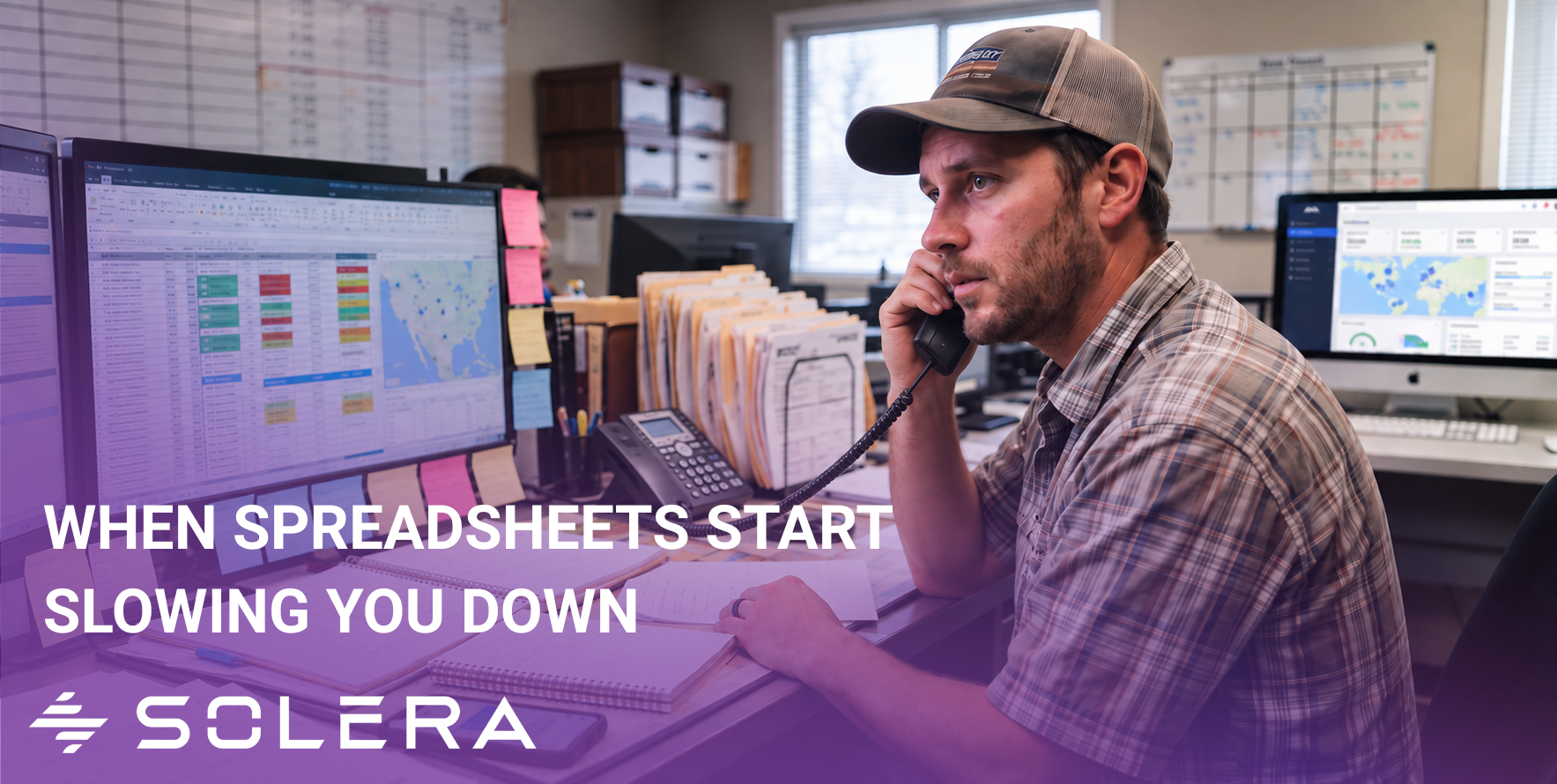
For many small fleets, spread sheets are where everything starts.
They track loads, driver information, customer details, delivery schedules, and countless other moving pieces. When you’re running just a few trucks, spreadsheets can be a practical and affordable way to stay organized.
But as your operation grows, so does the complexity of managing it.
More customers, more loads, more drivers, and more paperwork often mean more time spent updating spreadsheets, searching for information, and coordinating across multiple systems. What once felt manageable can quickly become difficult to maintain.
If any of these sound familiar, your fleet may be reaching the point where spreadsheets alone are no longer enough.
Sign #1: You’re Constantly Switching Between Multiple Systems
Does this sound familiar?
• Load information lives in a spreadsheet
• Driver updates arrive via text
• Customer communications happen through email
• Delivery paperwork is stored somewhere else entirely
When information is scattered across different places, simple tasks start taking longer than they should.
Instead of making decisions, dispatchers and fleet owners spend valuable time searching for information, updating records, and making sure everyone has the latest details.
Why It Matters
As fleets grow, disconnected processes can create bottlenecks that affect efficiency across the entire operation.
Sign #2: Customers Are Asking for Updates You Don’t Have Readily Available
In 2026, customers expect timely communication.
When a customer calls asking for a shipment update, it should require multiple phone calls, text messages, or emails to find an answer.
The larger a fleet becomes, the more difficult it can be to manually track every load and provide consisted updates.
Why It Matters
Providing reliable information helps build trust and creates a more professional customer experience.
Sign #3: Dispatch Is Becoming More Reactive than Proactive
As the number of trucks, loads, and drivers increases, dispatching becomes more challenging.
Instead of focusing on optimizing routes, managing capacity, or supporting drivers, dispatchers often find themselves putting out fires and responding to issues as they arise.
Operational visibility becomes harder to maintain when information is spread acoress multiple documents and communication channels.
Why It Matters
The more time spent reacting, the less time available for improving performance and customer service.
Sign #4: Administrative Work Keeps Growing Alongside Your Fleet
Growth should create opportunities for your team, not mountains of paperwork.
Yet many small fleets discover that adding trucks often means more manual processes, such as:
• More load tracking
• More customer communication
• More driver coordination
• More paperwork
• More billing tasks
If routine administrative work continues to increase with every new truck, your operation may be relying too heavily on manual processes.
Why It Matters
Long-term growth becomes difficult when efficiency doesn’t scale alongside your fleet.
Sign #5: Invoicing and Paperwork Are Slowing Down Cash Flow
Many fleet owners focus heavily on moving freight, but getting paid is just as important. When paperwork is difficult to locate, delivery information is incomplete, or documentation takes too long to process, billing delays often follow. Even small delays can create unnecessary cash flow pressure for growing businesses.
Why It Matters
The faster information moves through your operation, the faster you can invoice and get paid. The Sylectus content library identifies invoicing bottlenecks and slow billing workflows as common operational challenges for growing fleets.
The Bottom Line
Spreadsheets aren’t necessarily the problem. They’re often a sign that your fleet has reached a point where managing loads, drivers, customer communication and paperwork has become more complex than a manual process can comfortably handle.
If you’re finding it harder to stay organized, provide timely updates, or keep administrative work under control, it may be time to evaluate whether your current processes are supporting your business or holding it back.
The good news is that many of these challenges can be addressed by centralizing information and creating more consistent workflows across your operation.
Ready to Spend Less Time Managing Information?
Learn how Sylectus TMS helps small fleets centralize dispatching, visibility, customer communication, and invoicing in one place. Explore the solution and see how it can help your operation stay organized as it grows.
Button text to form: Learn how Sylectus TMS Simplifies Fleet Operations


Leave A Comment
You must be logged in to post a comment.